

Event planning is about creating thoughtful, balanced and immersive experiences. When event planning is concrete, then it will be reflected in fantastic execution. Taking care of these two aspects eventually leads to the success of the events. With the changing times, both physical and hybrid events are conducted in the corporate world. In both scenarios, technical glitches, uninterested attendees, budget constraints, exceeding the timeline, and other sorts of crises may occur. Thus, these events need to be strategised well to avoid unnecessary challenges. In today’s time, there should be a focus on pre-event engagement strategy along with post-event engagement strategy. The event team also has to be careful while planning events. To ensure the success of any event and keep the participants involved till the end of the event, we have some exciting event engagement ideas. Let’s understand all three phases one-by-one and organize memorable events.
Pre-Event Engagement Strategy
Considering Pre Event engagement strategy, it sets up the foundation of the event. Here, it deals with content creation, engaging the audience and expectation-setting before the initiation of the event.
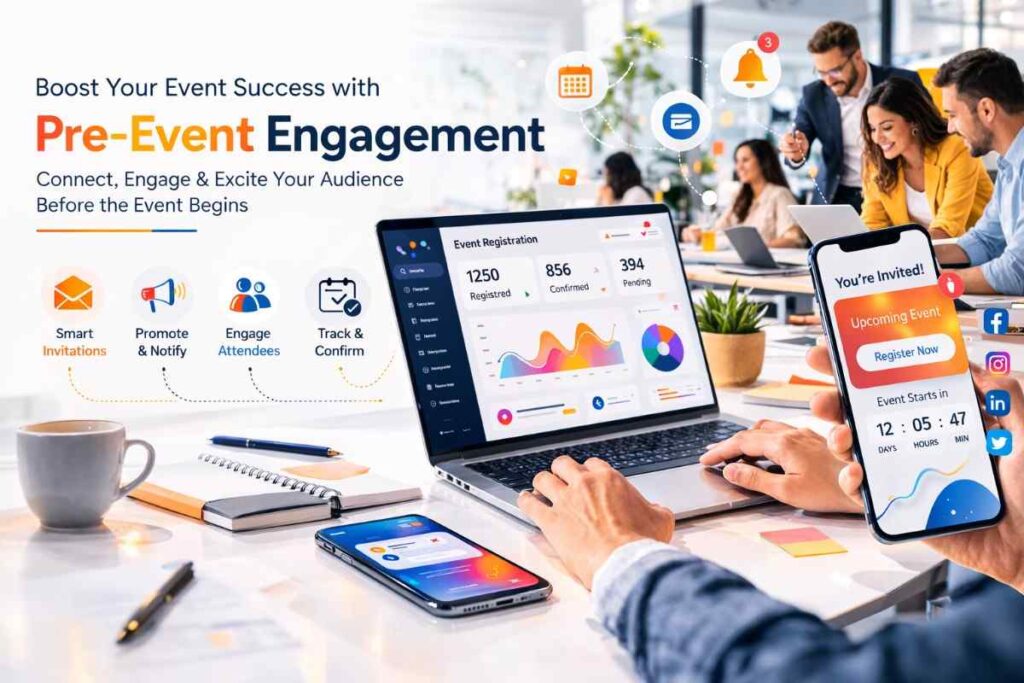
A. Make a Website for Upcoming Event: Create a website/landing page to share the details of the event. Make sure to mention the date, time and venue on the website. Also, add the event description, schedule of the event, sponsors, media partners and significant images to the website.
B. Pre-Event Marketing: Marketing plays a significant role in creating buzz about the event. Build the excitement through speaker interviews, pre-event polls, content details, videos as well as backstage clips.
C. Build a Bond with Audience: The success of the event depends on the footfall of the audience. Thus, it is crucial to make the audience emotionally invested in the event through user-generated content, personalised welcome videos and delivering valuable information to the audience.
D. Hire Influencers: In the pre-event phase, it is wise to hire influencers. These influencers are likely to make your events popular in their own unique ways. Thus, it is good to partner with them and bring more of the audience to the event.
During Event Engagement Strategy
During Event engagement strategy means the ways or techniques to keep the attendees excited and engaged with the event. This involves ideas that help in the smooth execution of the event.
A. Well-Prepared Speakers: Preparation is the key to a successful event. As the speakers are responsible to keep the audience immersed in the event, they need to be prepared with technology and schedules. They should be able to handle the chaos as well.
B. Keep it Interesting: Surprises are always welcomed by people, and they keep the element of fascination alive. By organizing VR games for corporate events, installing personalised photo booths, welcome kits and local treats etc., attendees can enjoy unforgettable experiences.
C. Plan Questions and Answers Session: During the event, there should be a scope of conversations and interaction with the audience. This opportunity can be created through live Q & A sessions. Organising Q & A sessions allow to understand different perspective of discussion. Apart from this, other interactive event ideas like quizzes, storytelling and games, etc. can be planned.
D. Breaks are a Must: Long events should be planned with strategic breaks. Breaks are meant to rejuvenate participants, allow time to process the session content, allow networking, and keep the attendees engaged till the session ends.
E. Backup Plans: There are immense possibilities for disruptions during the event. To handle such contingencies, appropriate backup plans should also be prepared. To tackle the audience in such scenarios, communication is the key.
F. Stay Active on Social Media: The world of social media has come with immense networking opportunities. Share live updates, images and videos of the event on these platforms and connect with social media users.
Post-Event Engagement Strategy
Post-Event Engagement Strategy basically deals with after-the-event engagement with the attendees. As event engagement is a continuous process, it ensures maintaining a relationship with the participants.

A. Polls and Surveys: Honest testimonials can be collected through post-event polls and surveys. A questionnaire about logistics, experience, speakers and content, etc. can be prepared and circulated to the attendees.
B. Content Sharing: The audience may like to revisit the session content and recordings. To refine the learning experiences, the content should be shared with the participants.
C. Express Gratitude: ‘A Note of Thanks’ is a great way to stay connected with the attendees even after the event. Express this gratitude through text messages or e-mails.
D. Gather Feedback: Feedbacks are the valuable tool to gain the attendees’ insight on the event. From booth design ideas to event activities to volunteers’ support and logistics, the suggestions for event betterment should be gathered.
How to Measure the Effectiveness of the Strategy?
A strategy is futile if it fails to produce the desired results. Thus, it is important to measure the effectiveness of the strategy clearly. The following points will help in measuring the effectiveness of the Strategy.
A. Return on Investment: With the revenue generation, it is easy to measure the impact of the event.
B. Generation of Lead: The effectiveness of the event can be gauged through the conversion of attendees to potential customers.
C. Participants’ Count: The popularity and the success of the event can also be understood by the number of participants present in the event. The arrival of attendees is also a measure of a successful event.
D. Social Media Engagement: The extent to which traffic is diverted to the company’s social media accounts also define the positive impact of the event.
E. Satisfaction Metrics: The value of the event can be perceived through participant satisfaction metrics.
As an event strategist, it is crucial to have clarity on the impact of an event engagement strategy. In fact, two or more metrics can be combined for comprehensive analysis.
The future of events lies a lot in the kind of planning and strategies used for successful execution. This is not just about tools and techniques but also about promotions and audience engagement. Nowadays, as people want memorable events, detailed planning from the beginning to the end must be done. It is also observed that the impact of event planning determines the success of the event. In fact, event management professionals should be flexible while designing any strategy for an event. Hence, it is advised to build a powerful pre, post and during event engagement strategy by following the above-mentioned event ideas.
FAQs
An event strategy is a detailed plan that covers resources, budget, audience, mode of events and goals of the event. This strategy should be designed to match the organisational goals.
To decide the right Event Format, several aspects are to be considered. These aspects are the size of audience, their age, academic background, ethnicity and gender. Other important factors to be considered are funds, resources and event goals.
To deal with technical problems at the event, there should be a Help Desk at physical events. Apart from the Help Desk, prepare volunteers to help the participants.
In case of virtual events, have a team of Technical experts.
Event Engagement Strategy is equally effective for physical, hybrid and virtual events. A well-planned event aims at building connections, enhancing learning outcomes and delivering maximum value.